Overview
Designing a social real-estate platform for founders facing housing instability.
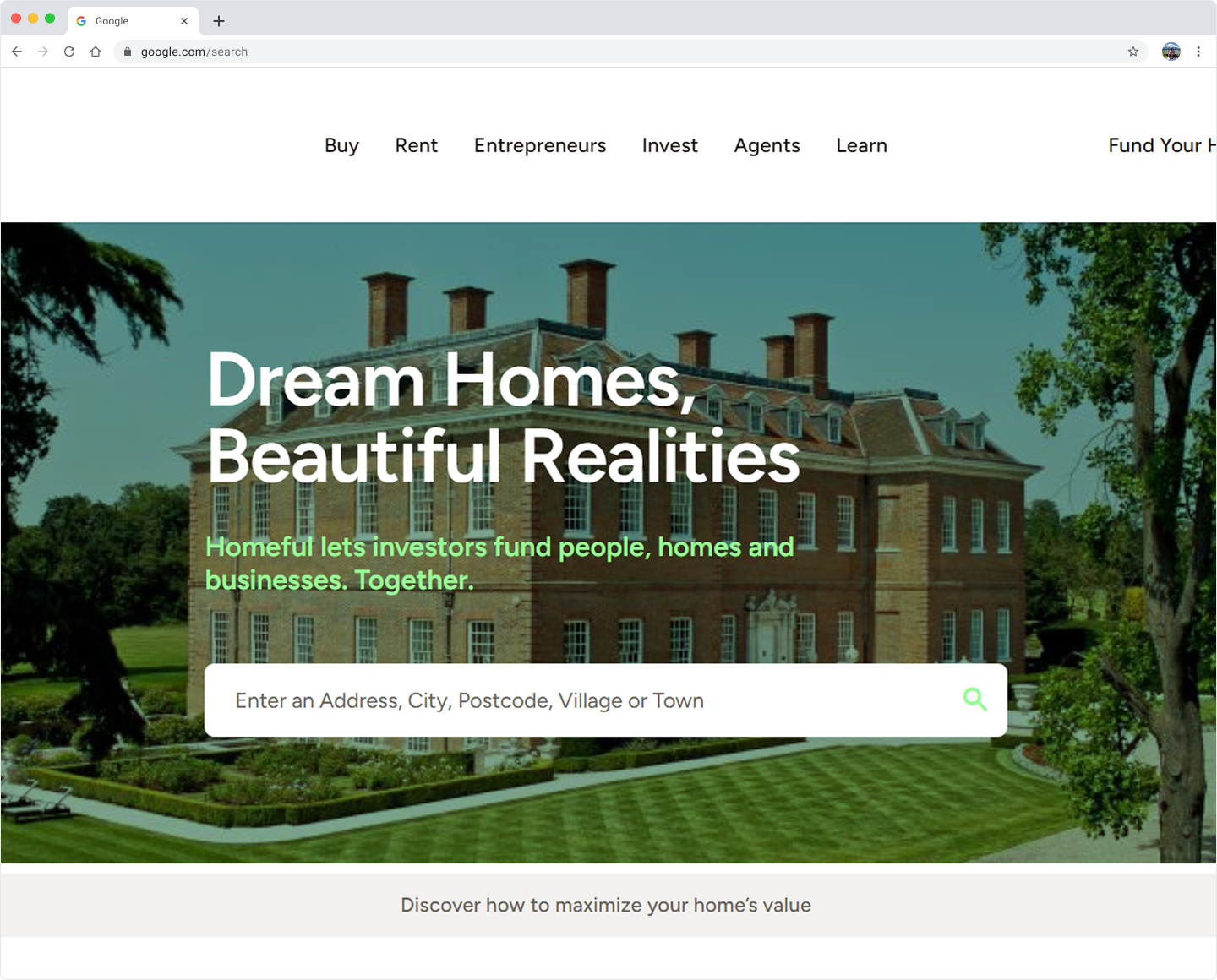
Homeful explores how technology, community and alternative housing models could help founders move from housing insecurity towards stability, financial resilience and ultimately home ownership.
The challenge was not simply to design another property platform, but to rethink the housing journey for people whose income, careers and lifestyles do not always fit traditional rental and mortgage systems.
Role: Founder / Product Designer / UX Lead
Responsibilities: Product Strategy, UX/UI Design, Information Architecture, Prototyping, Web Design
Platform: Responsive Web + Mobile App Vision
Year: 2026
Status: Live Beta / Active Development
Live beta: Homeful is currently in active development. Some areas of the live product are still being built and refined as the MVP evolves.
How I Led the Work
I led the product from problem definition through to service model, MVP and interface concept.
Direction: shaped the housing progression model and defined what the first release needed to prove.
Decision making: established how trust, safety and social impact should balance with long-term sustainability.
Communication: translated the broader vision into a product structure that could be understood by stakeholders, collaborators and future technical teams.
01 The Challenge
The housing system wasn’t designed for everyone.
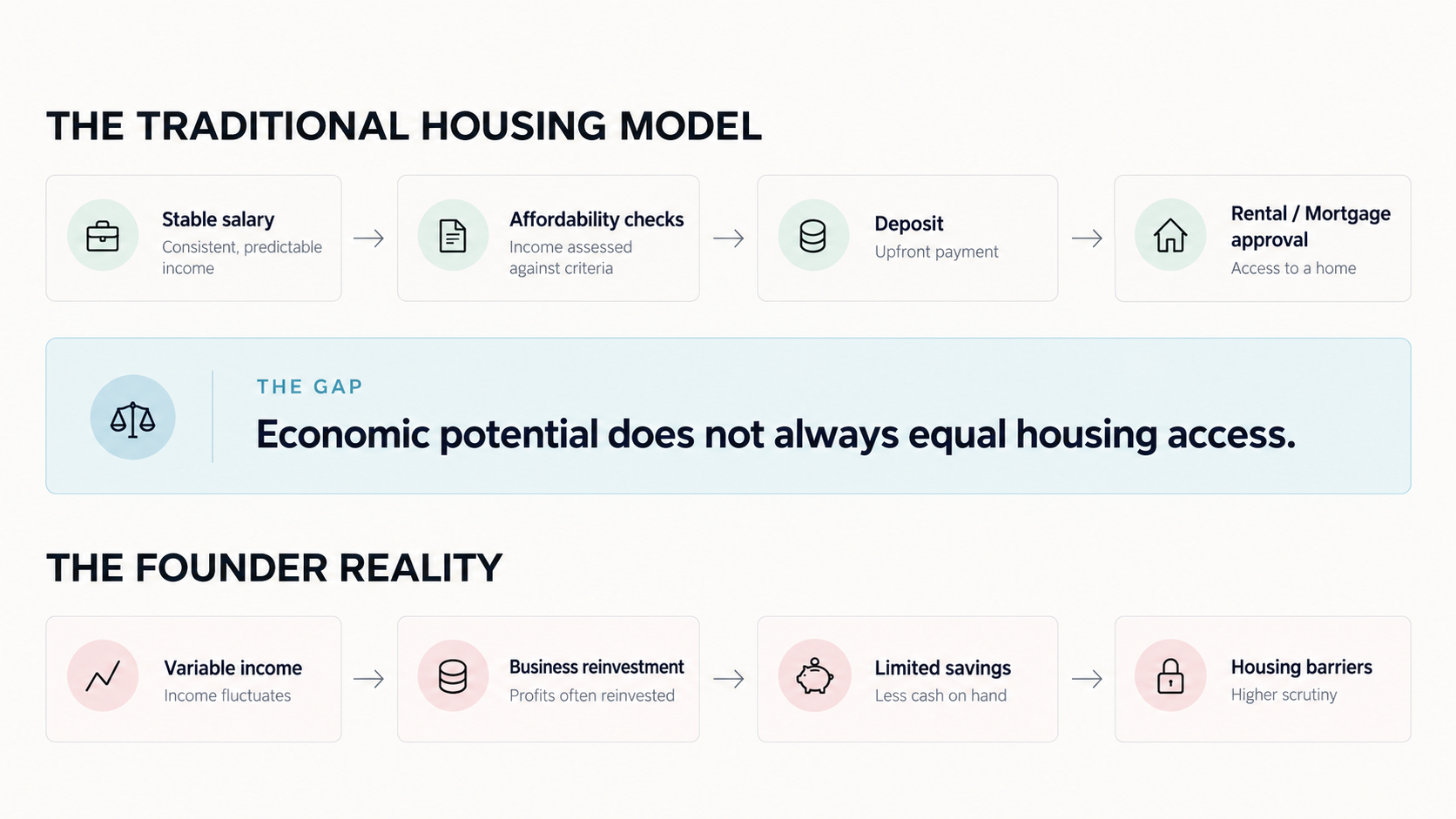
Traditional routes into secure housing are largely built around predictability: stable salaries, conventional employment histories, deposits, credit profiles and long-term financial records.
But the people building new businesses do not always look predictable on paper.
Founders, freelancers and early-stage entrepreneurs can experience fluctuating income, periods without salary and increased personal financial risk while they build their ventures. Even where future earning potential is strong, accessing stable housing can become difficult.
This creates a contradiction:
The very people taking risks to build businesses, create jobs and generate economic value can find themselves excluded from one of the foundations they need in order to succeed — a stable place to live.
Homeful began by asking a different question:
What if housing could recognise potential, not just predictability?
Instead of treating housing instability as an isolated moment of crisis, Homeful explores how a digital platform could support a longer journey from insecure housing to stability, financial resilience and ultimately ownership.
The product opportunity
Homeful reframes housing instability as a journey rather than a single transaction.
The opportunity is to create a trusted digital service capable of bringing together:
People who need housing
Founders and entrepreneurs navigating periods of housing instability.
Housing opportunities
Properties, rooms and alternative housing models that may not be visible through conventional channels.
Financial progression
Tools and pathways that help members improve stability and move towards long-term ownership.
Community and support
A network designed around the realities of entrepreneurship rather than treating housing separately from work, wellbeing and financial resilience.
Homeful isn't an Airbnb for founders.
It isn't Rightmove for vulnerable people.
And it isn't simply a homelessness charity platform.Homeful is a housing progression platform designed to help founders move from instability towards ownership.
02 Designing For the Founder Between Worlds
Building for people whose lives do not fit neatly into traditional housing criteria
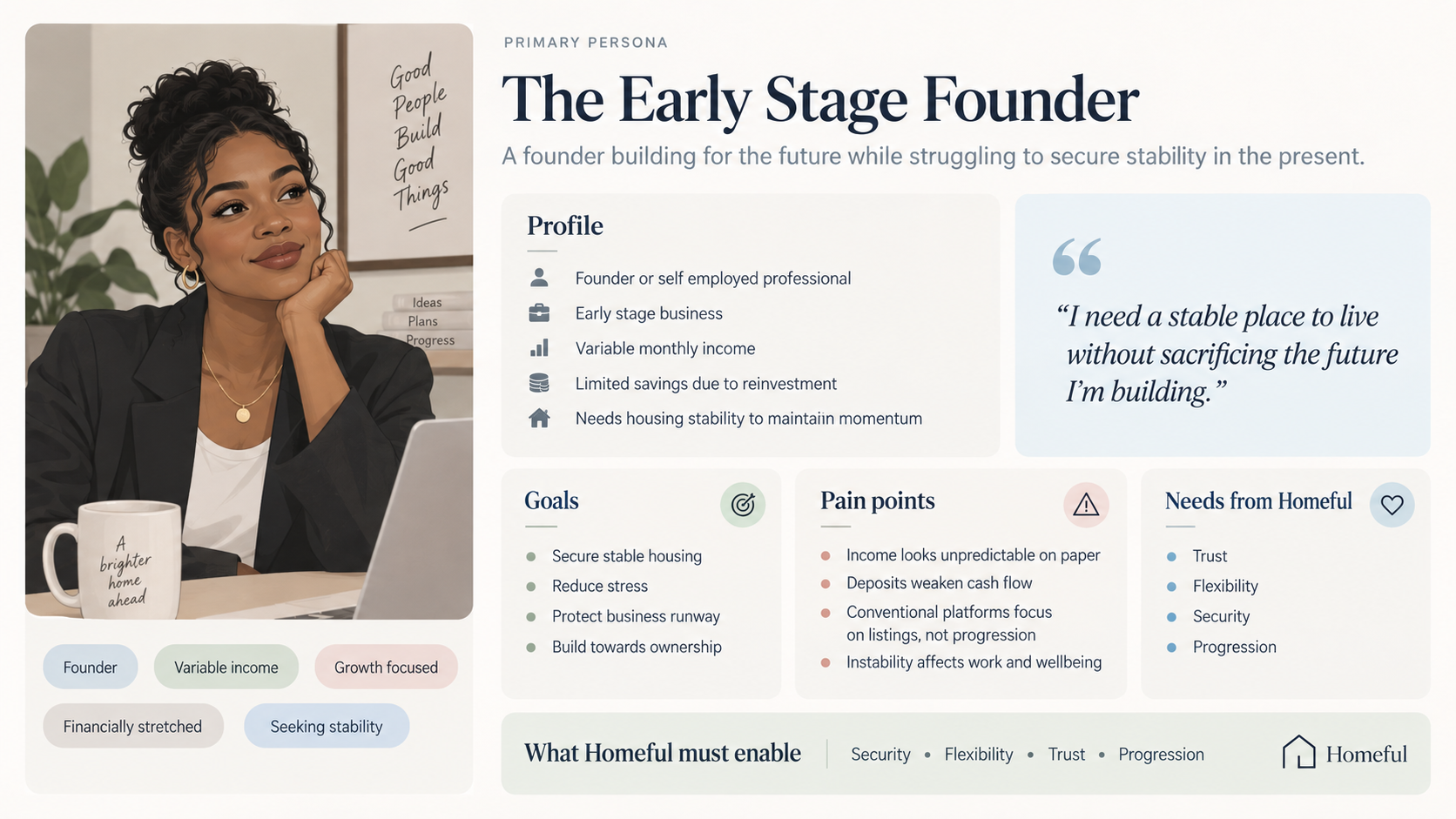
Homeful is designed for founders and self-employed professionals whose housing needs can become disconnected from their long-term potential.
Their challenge is rarely just finding somewhere to live.
They may be balancing business growth, unpredictable income, personal finances, mental health needs, relocation, funding rounds and the pressure to maintain stability while building something new.
This means the product needs to understand more than affordability alone.
It needs to understand context, progression and potential.
The core user need
“Help me find a stable place to live without forcing me to choose between building my future and securing my present.”
This became the foundation for Homeful’s product experience.
Flexible access should not mean lower standards.
03 Mapping the Housing Journey
From instability to ownership
A founder’s housing needs change over time. Homeful is designed around that progression, supporting users through each stage rather than treating housing as a one-off transaction.
1. Housing Instability
Temporary accommodation, staying with friends or family, unaffordable rent, risk of losing housing.
→
2. Immediate Stability
Access to a safe, suitable and affordable place to live.
→
3. Financial Recovery
Rebuilding savings, improving cash flow and creating greater predictability.
→
4. Housing Readiness
Developing the financial profile and stability needed for longer-term housing options.
→
5. Ownership
Progressing towards secure, long-term housing and ultimately home ownership.
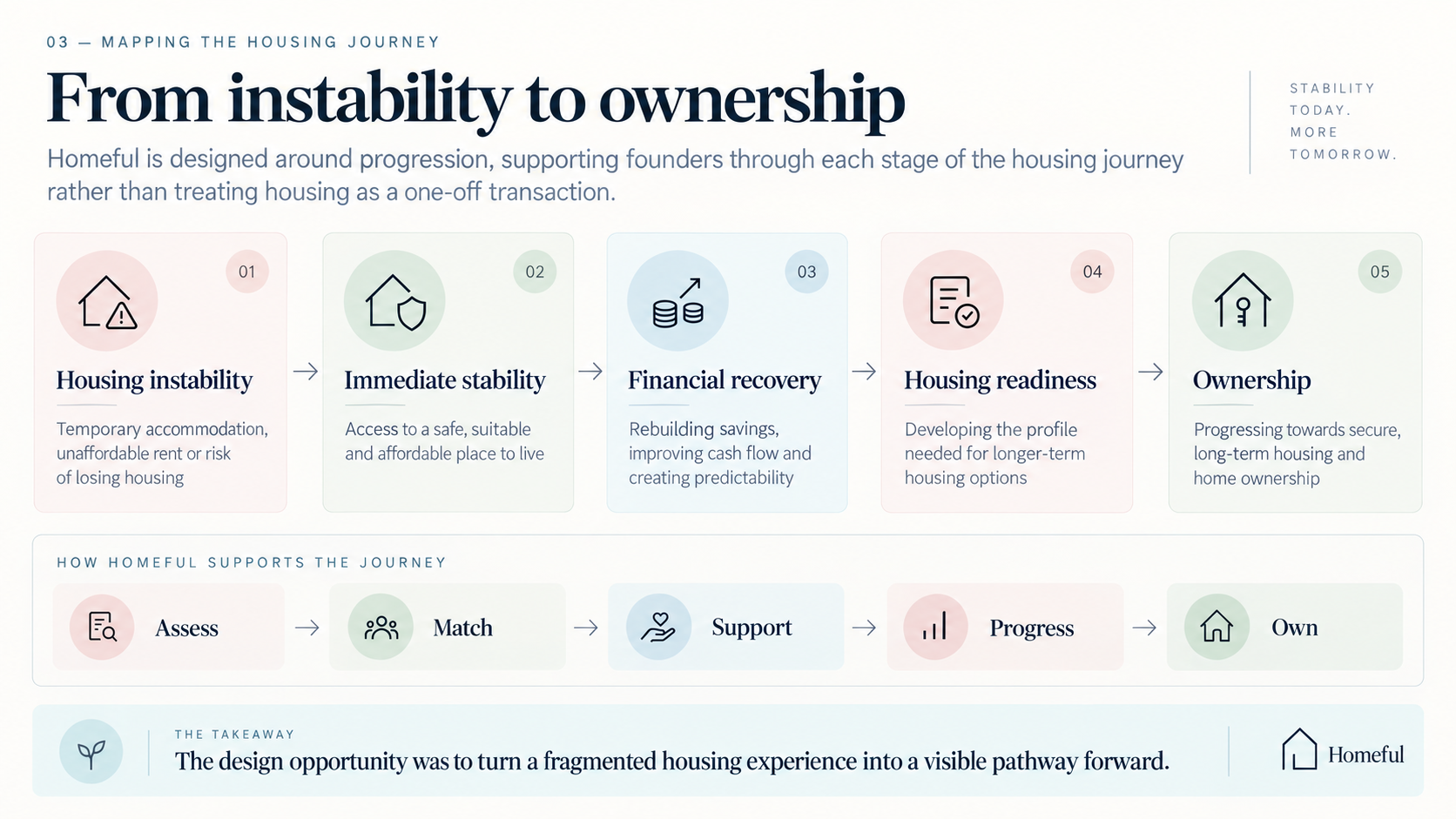
The design opportunity was to turn a fragmented housing experience into a visible pathway forward.
04 Designing Trust & Safety
Trust had to be designed into the product from the very beginning.
Housing is not a low-risk transaction.
Homeful needs to create confidence for everyone involved: founders seeking housing, property partners, community organisations and future financial partners.
That means the experience cannot rely on matching alone.
It needs clear verification, transparent criteria, responsible affordability checks and safeguards that protect both users and housing providers.
The product therefore needed to balance two things:
Making access more flexible without making the system less safe.
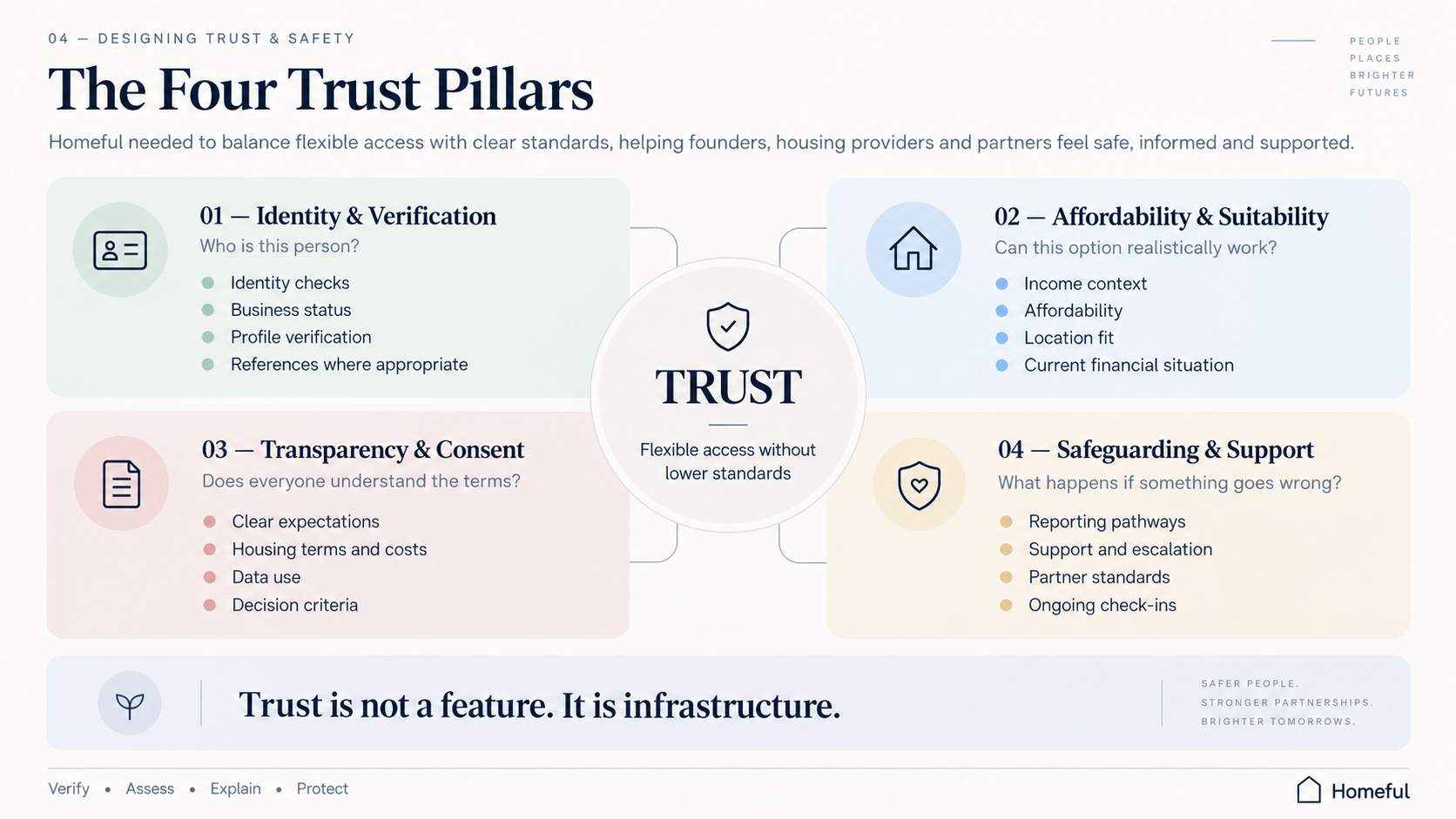
The design opportunity was to turn a fragmented housing experience into a visible pathway forward.
Homeful as a system
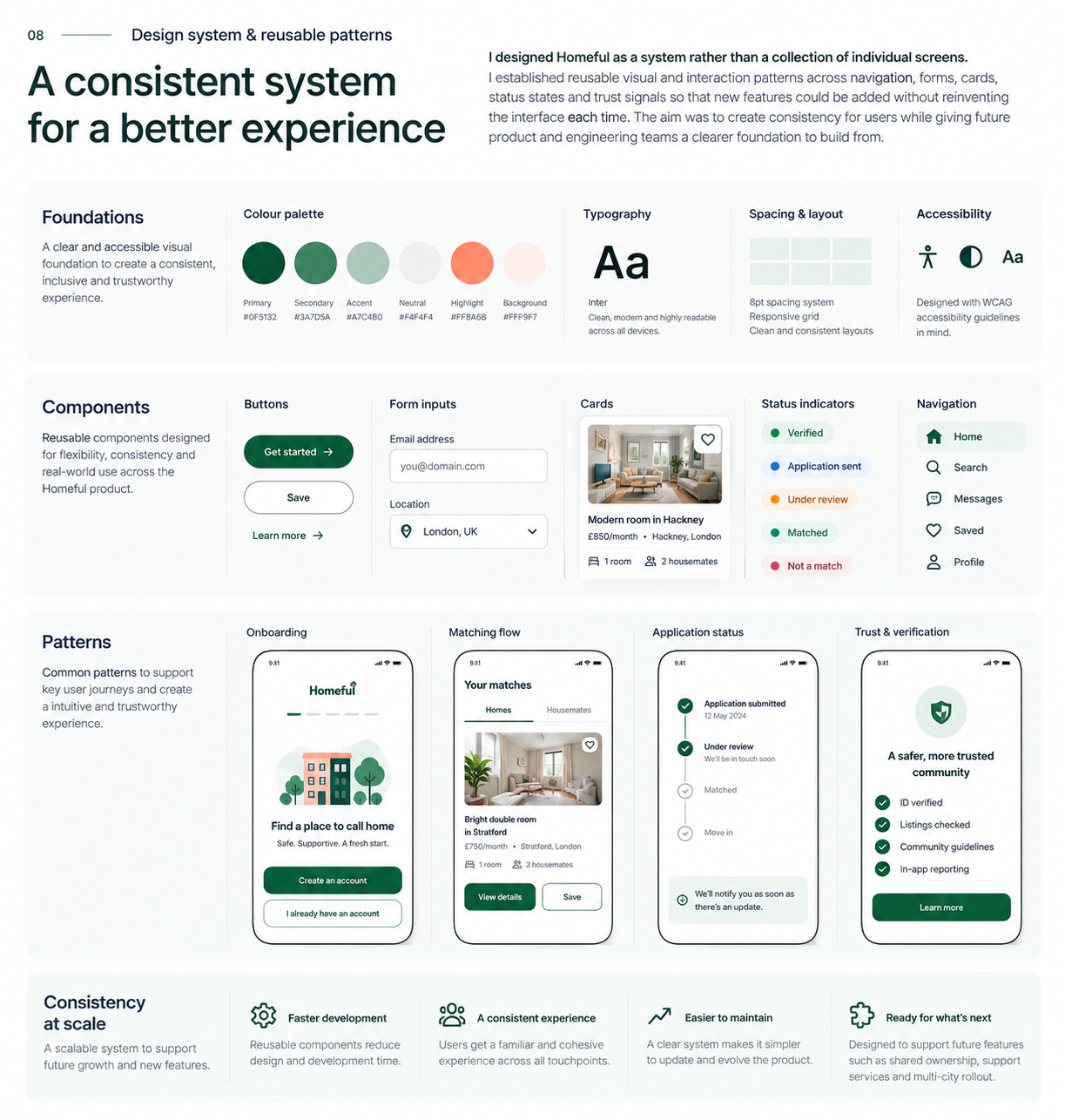
I designed Homeful as a system rather than a collection of individual screens.
The interface was structured around reusable foundations, components and interaction patterns so that the product could grow without reinventing the experience each time. My aim was to create consistency for users while giving future design and engineering teams a clearer foundation to build from.
FOUNDATIONS:
Typography, spacing, colour, layout and accessibility principles established the visual language of the product.
COMPONENTS:
Reusable buttons, inputs, cards, navigation, status indicators and trust signals helped maintain consistency across the experience.
PATTERNS:
Common journeys such as onboarding, verification, matching, progress tracking and confirmations were designed as repeatable interaction patterns rather than isolated screens.
BUILT TO SCALE:
Thinking in reusable systems made it easier to extend Homeful into new features and future journeys while keeping the experience coherent and reducing unnecessary design and engineering effort.
And the pull quote was:
“The goal was not just to design screens, but to create a product language that could scale with Homeful.”
05 The Homeful Matching Model
Matching needed to go beyond listings.
Traditional property platforms are often designed around search, location and price.
But Homeful needed to think more carefully about fit.
A suitable match is not simply the cheapest available room or the nearest property. It is the option most likely to support a founder’s stability, current reality and long term progression.
This meant designing a matching model that considered both housing needs and personal context.
What Homeful matches
Homeful brings together five key inputs:
Founder profile
Who the user is, what stage they are at and how their income currently works.
Housing need
Whether they need immediate accommodation, short term stability or a pathway towards longer term housing.
Affordability context
A broader view of financial reality, including income patterns, available budget and capacity for housing costs.
Location fit
Where the founder needs to live in relation to work, community, transport and support networks.
Trust and suitability
Verification, partner criteria, safety requirements and practical fit for both the founder and the housing provider.
The design principle
The goal was not just to match people to homes, but to match people to the right next step.
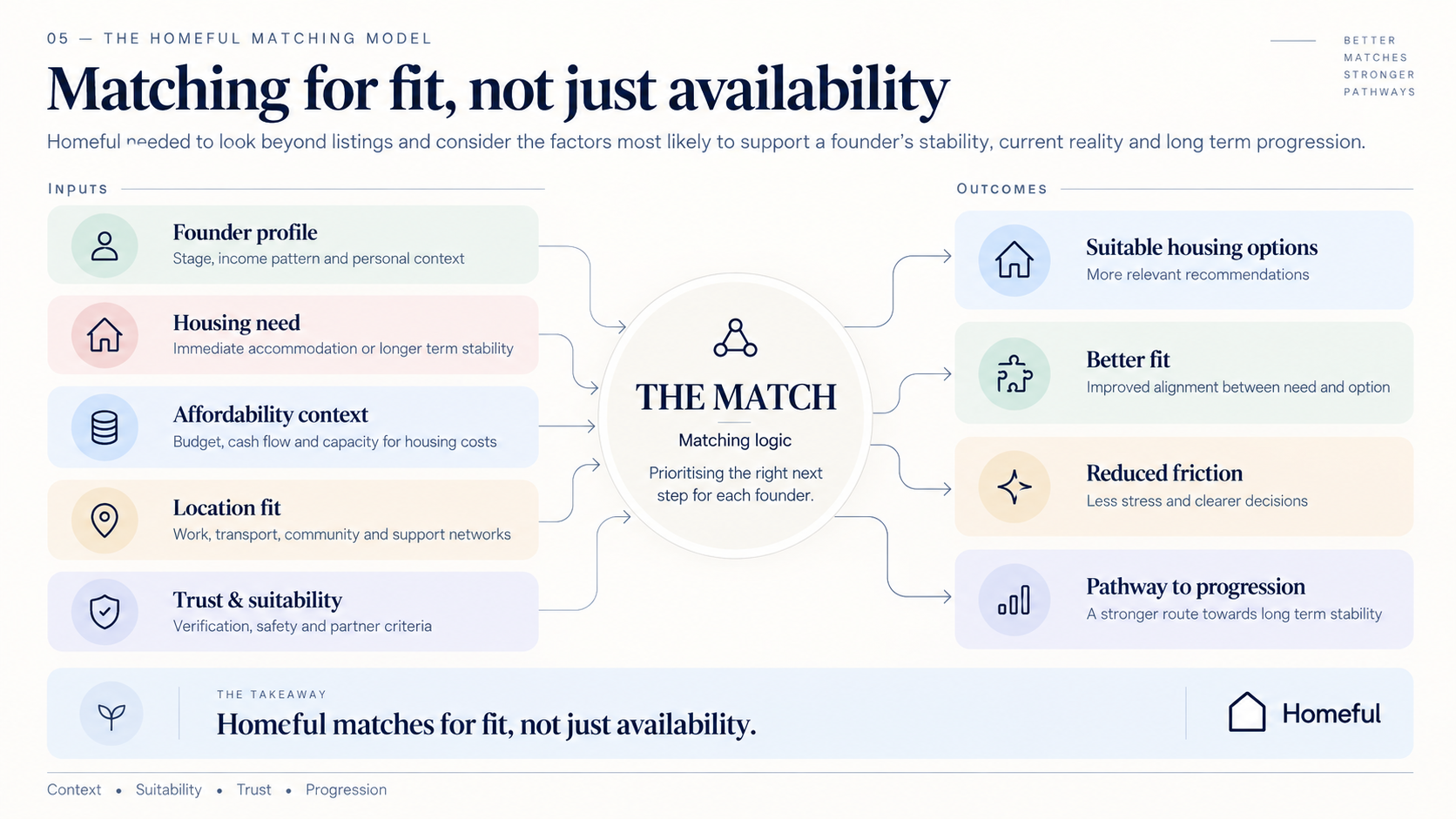
The Matching Model
Homeful matches for fit, not just availability.
How the system thinks
Rather than presenting every property equally, Homeful would prioritise options based on relevance, suitability and progression.
This allows the platform to support better decision making at moments when users may already be under financial or emotional pressure.
In practice, the model helps answer questions such as:
-
Is this option realistically affordable right now?
-
Does this location support the founder’s daily life and work?
-
Is the housing type appropriate for their stage of stability?
-
Does this match create a stepping stone towards stronger future options?
-
Does it meet the trust and safety standards expected by all sides?
Why this matters
A stronger matching model helps reduce poor placements, improves trust for housing partners and gives founders a clearer route towards stability.
This makes the product more valuable not only for users, but for the wider ecosystem supporting them.
06 Designing the service behind the product
The experience only works if the service behind it works too.
Homeful connects founders with housing opportunities, but the visible digital experience is only one part of the system.
Behind every successful match sits a wider service involving verification, property partners, support processes, communication, decision making and ongoing progression.
The challenge was therefore to design not only what the user sees, but also what needs to happen behind the scenes to make the experience reliable.
The service blueprint
The Homeful experience can be understood across four connected layers:
Founder actions
Create a profile, describe housing needs, complete verification, review matches, apply, move in and track progress.
Frontstage experience
Onboarding, recommendations, application status, messaging, support and progression tools.
Backstage operations
Verification checks, matching logic, partner coordination, affordability review, case management and escalation.
Partner ecosystem
Housing providers, landlords, community organisations, financial partners and support services.
The aim is to make a complex service feel simple from the founder’s point of view.
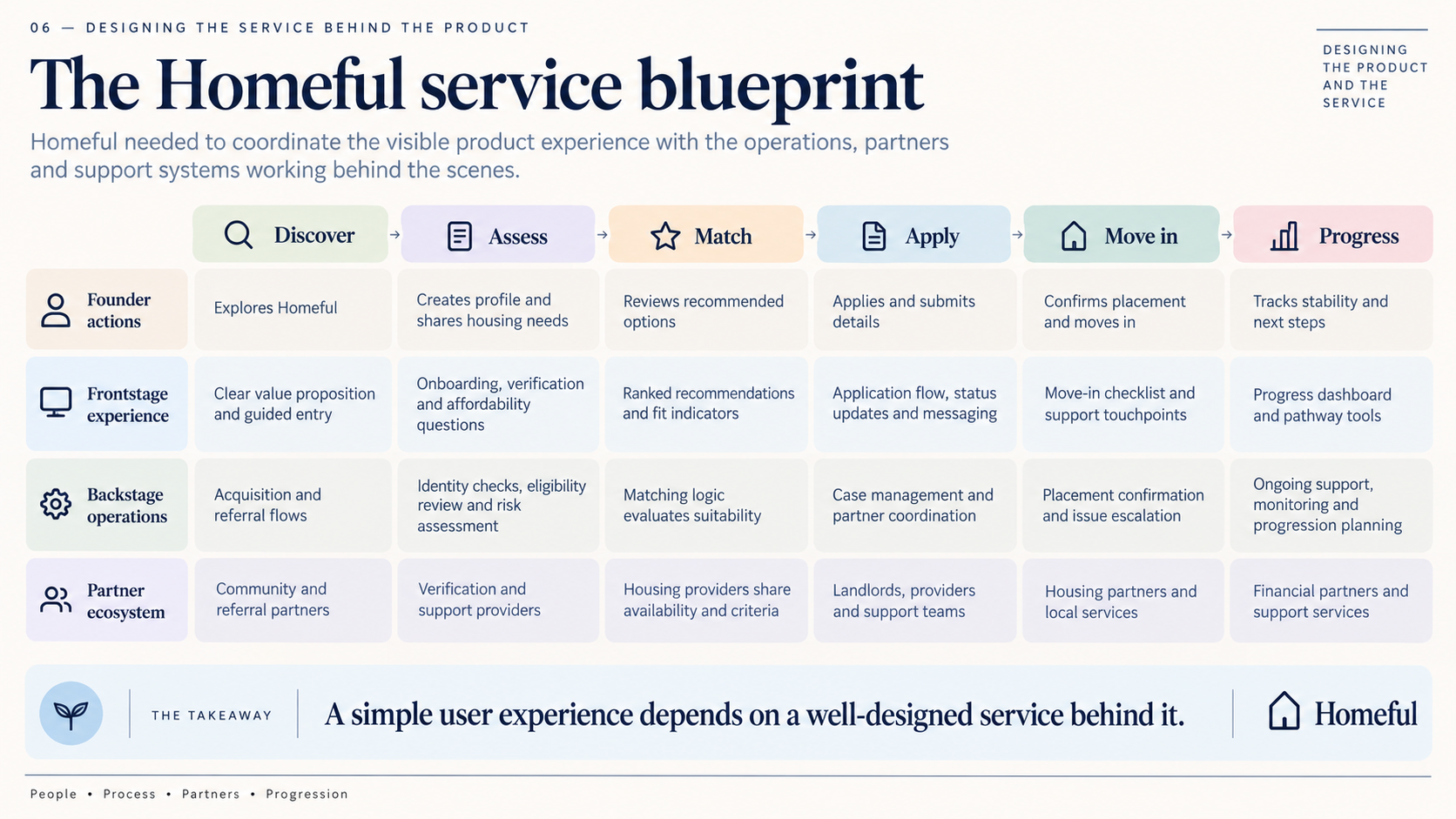
The Service Blueprint
Simple UX depends on a well-designed service
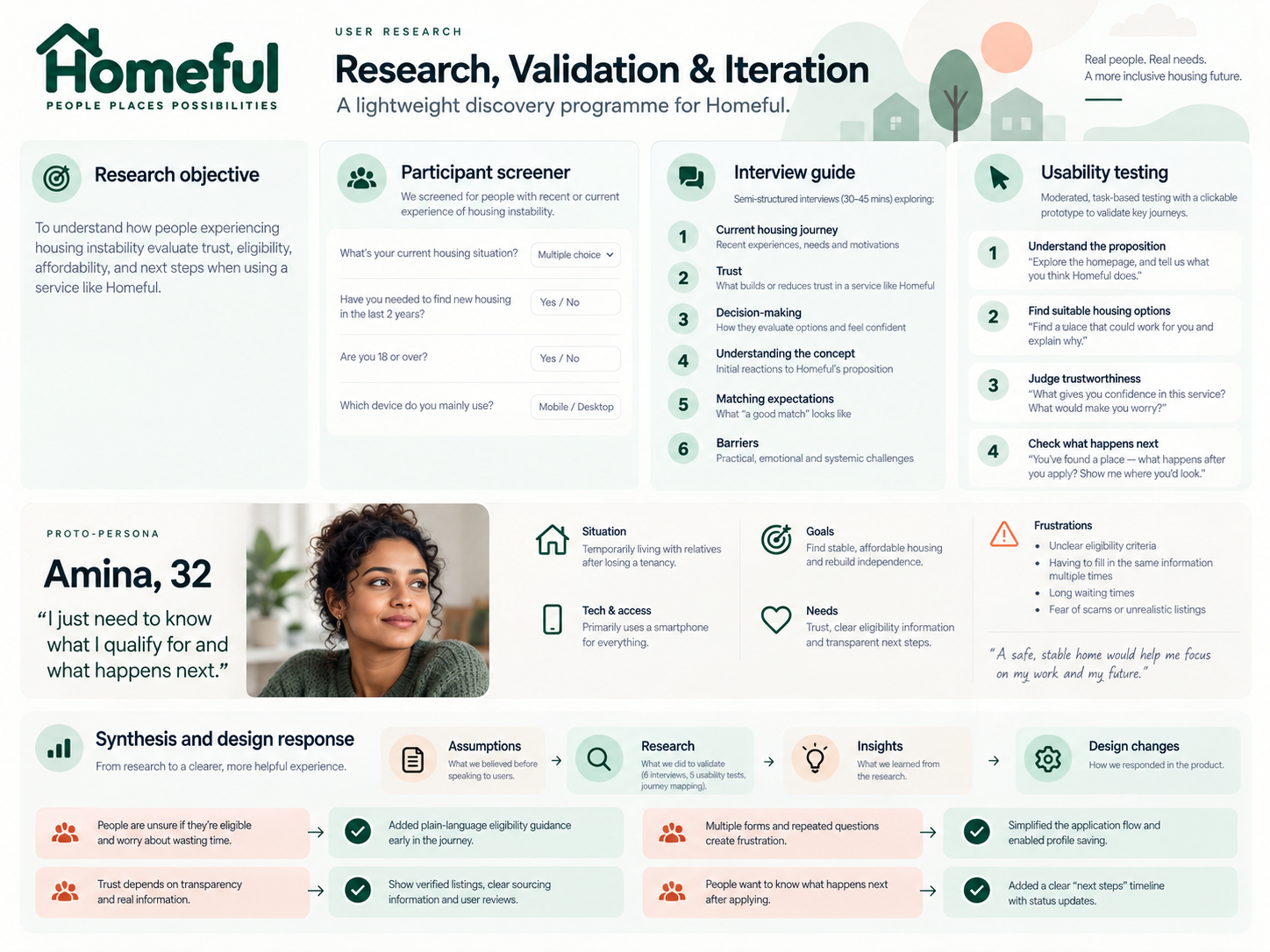
Research, validation & iteration
I structured a lightweight discovery programme to understand how people experiencing housing instability evaluate trust, affordability, eligibility, and progress when navigating housing services. The research included participant screening, semi-structured interviews, usability testing, and synthesis of recurring behavioural patterns.
Findings were used to refine trust signals, clarify application status, simplify onboarding, and make the matching journey easier to understand.
07 Defining the MVP
This case study documents the product direction and design thinking behind an evolving platform. The live experience represents the current build, not the final product vision.
Start with the smallest experience that proves the model.
Homeful’s long term vision is ambitious, but the first version does not need to solve every part of the housing journey at once.
The MVP should focus on one core question:
Can Homeful help a founder in housing instability find a more suitable and trusted housing option than they could through a traditional property platform?
That means prioritising the features that support discovery, assessment, matching and application, while leaving more complex financial and ownership tools for later stages.
What the MVP includes
Founder onboarding
A guided profile covering housing needs, location, income context and current circumstances.
Identity and eligibility checks
Basic verification to build trust and ensure users meet the platform’s criteria.
Housing partner listings
A curated supply of suitable rooms, homes and partner-managed housing opportunities.
Matching and recommendations
Relevant housing options ranked using need, affordability, location and suitability.
Application and status tracking
A simple way to apply, understand what is happening and receive updates.
Support and escalation
Clear routes to contact Homeful when additional help is needed.
What comes later
Features such as financial coaching, savings tools, mortgage readiness, ownership pathways and deeper partner integrations belong to the wider product roadmap rather than the first release.
The MVP is designed to test the most important assumption first:
Can better matching create better housing outcomes?
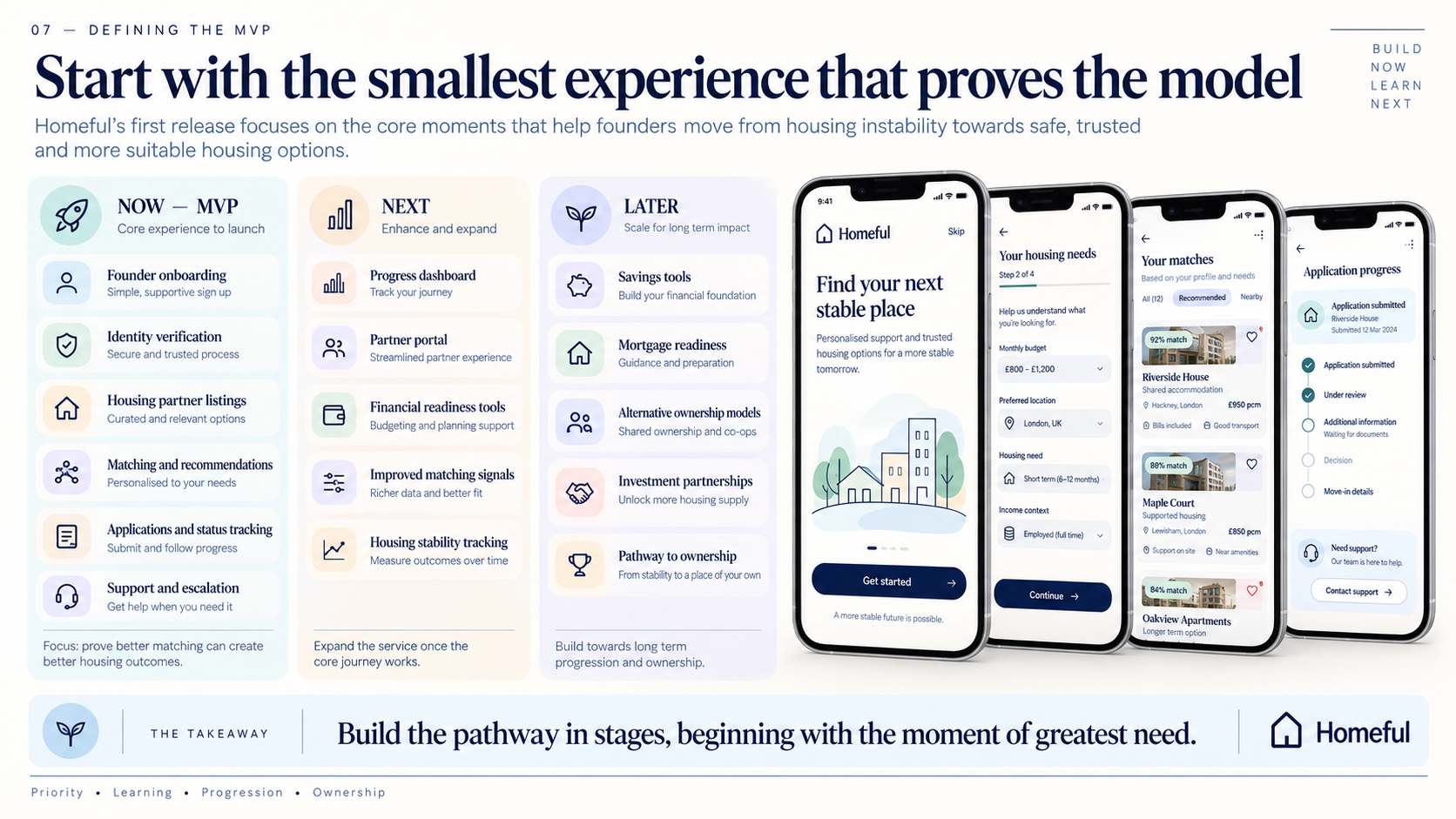
Defining the MVP and Product Roadmap
A phased product strategy showing how Homeful could launch with a focused core experience, validate its matching model and progressively expand towards financial readiness and home ownership
08 Measuring Success
Success is more than getting someone into a property.
For Homeful, the real measure of success is whether users move towards greater housing stability over time.
That means evaluating both the immediate product experience and the longer term outcomes the service is designed to create.
Product metrics
Match relevance
How often recommended housing options are viewed, saved or applied for.
Time to suitable match
How quickly a founder moves from onboarding to a realistic housing option.
Application conversion
The percentage of suitable matches that progress into completed applications.
Placement success
How many applications result in confirmed housing placements.
Experience metrics
User confidence
Whether founders feel they understand their options and next steps.
Partner satisfaction
Whether housing providers consider the matching process useful, reliable and efficient.
Support demand
Where users need additional help, revealing areas of friction in the service.
Impact metrics
Housing stability
How many users remain securely housed after placement.
Financial progression
Whether users improve savings, affordability or financial readiness over time.
Progression towards ownership
How many members move into stronger long term housing positions and ultimately towards ownership.
The ultimate measure
Homeful succeeds when housing stops being a barrier to the future someone is trying to build.
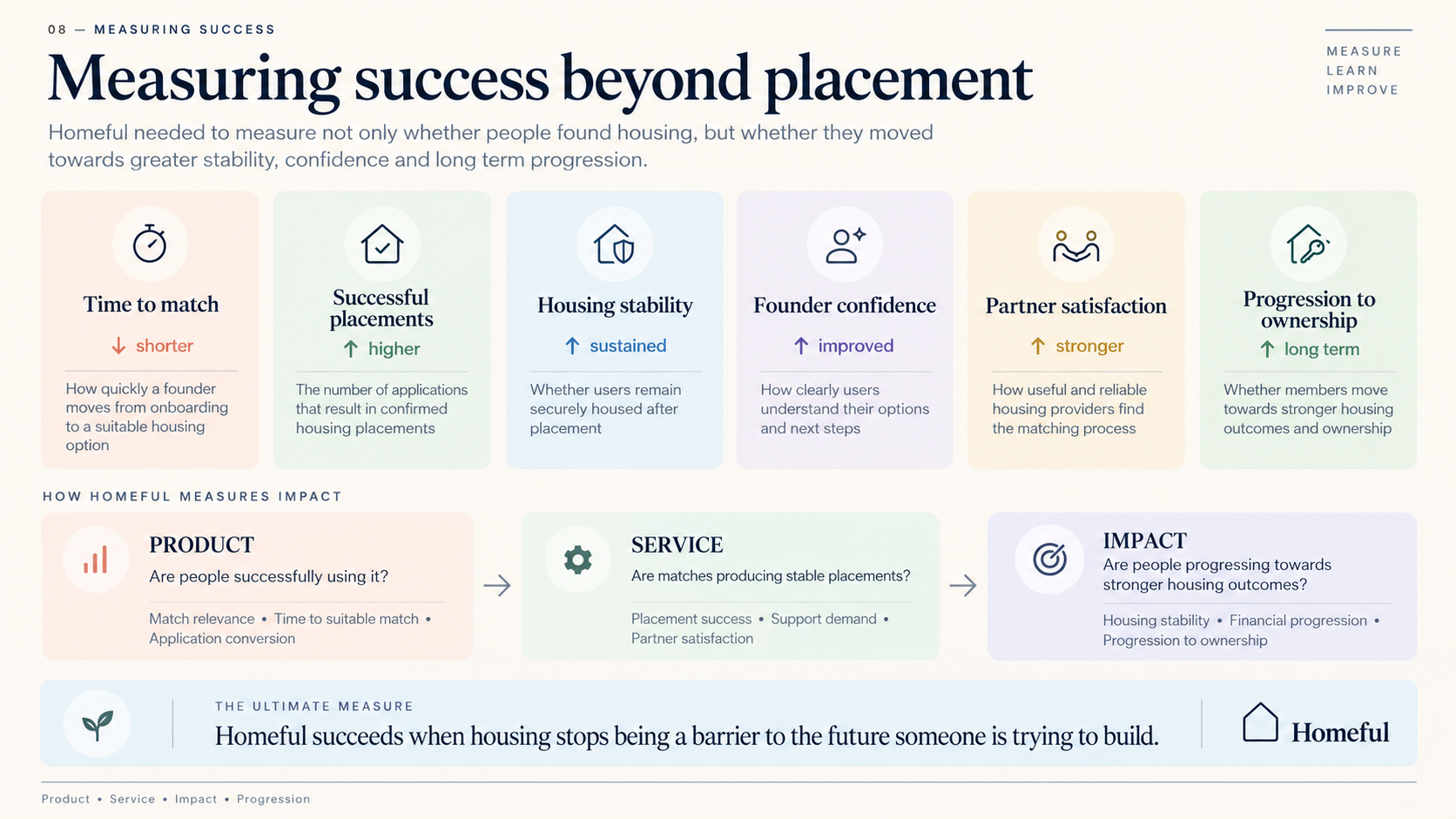
Measuring Success Beyond Placement
A product and impact measurement framework for Homeful, tracking not only how effectively users find suitable housing, but whether the service improves long term stability, confidence and progression towards ownership
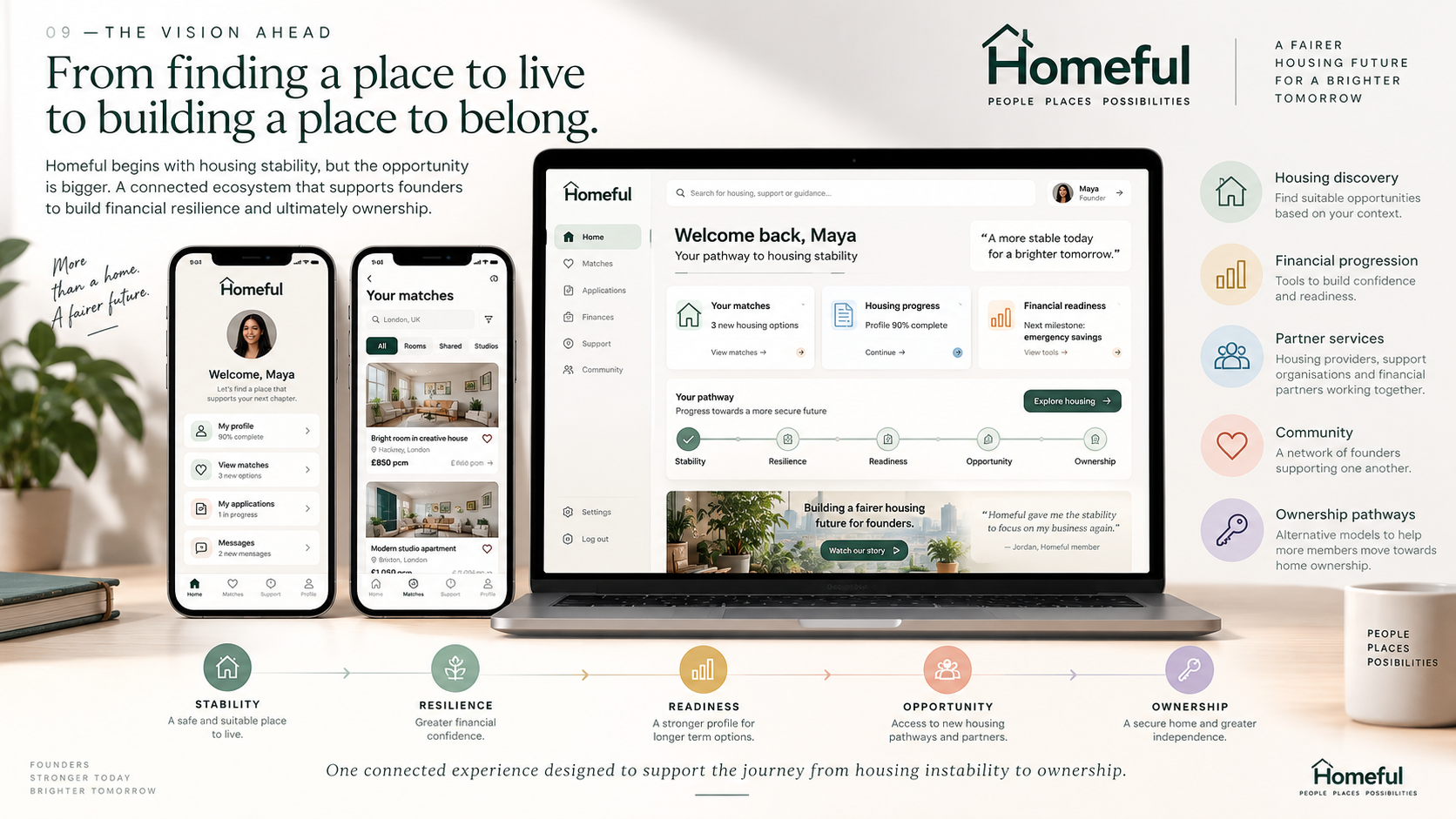
09 Vision Ahead
From finding a place to live to building a place to belong.
Homeful begins with housing stability, but the longer term opportunity is much bigger.
The platform could evolve from helping founders secure suitable housing into a wider ecosystem supporting financial resilience, stronger housing choices and ultimately ownership.
The vision is not simply to help someone solve an immediate housing problem.
It is to help them move forward.
A longer term progression model
Stability
Secure somewhere safe and suitable to live.
Resilience
Build greater financial confidence and predictability.
Readiness
Strengthen the profile needed for longer term housing options.
Opportunity
Access alternative ownership models, financial partners and new housing pathways.
Ownership
Progress towards a secure home and greater long term independence.
One connected Homeful experience
Over time, the Homeful ecosystem could connect:
Housing discovery
Finding suitable opportunities based on context rather than listings alone.
Financial progression
Tools that help members understand affordability, savings and readiness.
Partner services
Housing providers, support organisations and financial partners working through one coordinated platform.
Community
A network of founders supporting one another while building businesses and greater personal stability.
Ownership pathways
Alternative models designed to help more members move from renting and temporary housing towards ownership.
The future Homeful is designing for
Housing should not be the reason someone has to stop building their future.
Homeful imagines a system where stability becomes the foundation from which people can build businesses, communities and eventually homes of their own.
The Homeful Vision: From Stability to Ownership
A connected product ecosystem showing how Homeful could evolve across mobile and desktop to support founders from immediate housing stability through financial resilience, readiness and ultimately home ownership